Showing posts with label Race. Show all posts

Tuesday, January 23, 2018

The Endless American Horror


The Endless American Horror: Lynching and Police

Author's Note: Please note that this article contains graphic descriptions of lynchings. Discretion is advised.

This article was originally published on AHTribune.com.


In 1918 Brook County, Georgia, a local plantation owner was killed by Sidney Johnson, a black man who had been leased out to the plantation via the convict lease system, in a dispute over unpaid wages. Upon hearing this, the white community went on a rampage and lynched not only Johnson, but anyone they thought to even be remotely involved in Johnson’s decision. One of these men was Hayes Turner. Not only was he lynched, but also castrated.

Turner’s wife, Mary, who was eight months pregnant at the time, began to speak out against her husband’s lynching; unfortunately, she too, became a victim. A white mob “hanged her by her feet, set her on fire, sliced her stomach open, and pulled out her baby, which was still alive.” They stomped on the child’s head, killing it. Then the mob “[took] the time to sew two cats in Mrs. Turner's stomach and making bets as to which one would climb out first.” [1]

This can be described as nothing short of demonic. In many ways, even that fails to fully encompass the horror and pure wickedness of this event. Though, the only thing more horrid is that in a way, lynchings continue in the form of police murder.

Before delving into the connections between the aforementioned violence, it is imperative to first understand lynching. The origins of lynching truly lie in slavery where “there were numerous public punishments of slaves, none of which were preceded by trials or any other semblance of civil or judicial processes. Justice depended solely upon the slaveholder.” [2] Punishment ranged from lashings to family separation to mutilation and branding. The overall idea behind these actions were that black people were not human beings, in a way, they weren’t even property, they were just things, lesser than both humans and animals. This mindset continued in the post chattel slavery era, where slavery took on the form of both the convict leasing and sharecropping systems respectively. Yet, it also took place in the form of mob violence against blacks.

There have been many explorations as to the reasoning behind lynching. E.M. Beck, a professor of sociology at the University of Georgia, posited the argument that lynching was linked to the cotton markets. He argued that lynchings “[increased] during times of sparse cotton revenues, and declining with increasing cotton profits.” The lack of profit from cotton led unemployed whites to want to replace black workers and that “Mob violence was a form of intimidation to facilitate this labor substitution.” [3] While further studies have shown that fluctuations in cotton pricing don’t explain lynching [4], it should be noted that white elites would have an interest in fueling white angst into hatred against blacks, effectively utilizing poor whites as foot soldiers in their mission to maintain the current racial and economic hierarchy.

The cause of lynching was first and foremost the culture of white supremacy that had existed for the past two centuries or so. Blacks became scapegoats for many of the problems that were going on and thus a subculture of violence that had arguably already taken root in the days of slavery, took on new form. “The existence of a subculture presupposes a complex pattern of norms, attitudes and actions” which “reflects 'a potent theme of violence current in the cluster of values that make up the life-style, the socialization process, [and] the interpersonal relationships of individuals living in similar conditions.” [5] Effectively, violence becomes normalized and is used as a tool of to socialize and condition people as to how the society operates.

This normalization and conditioning can be seen in the form of the lynching. Lynchings were very much a community affair in which legal authorities seldom if ever got involved as “the judge, prosecutor, jurors and witnesses—all white—were usually in sympathy with the lynchers” and “local police and sheriffs rarely did anything to defend Negro citizens and often supported lynchings.” [6]

Newspapers as well were extremely biased in covering lynchings. “Southern editors often used sympathetic language in describing lynch mobs while reserving callous damnation for lynch victims. The southern press was extremely creative when it came to providing moral, if not legal, justification for the action of lynch mobs.” We can see the affect that journalists had on the public’s view of lynching in the case of the murder of the Hodges family in Statesboro, Georgia. [7]

Henry and Claudia Hodges lived on a remote farm, near a black community, some of whom were the employees of the Hodges. Late on the night of July 28, 1904, two men saw the Hodges home aflame. They went to investigate and found the mutilated, charred remains of the entire family. The suspected motive was robbery as it was known that Hodges was better off than most farmers and it was even rumored that he possibly had several hundred dollars stashed away on his property.

The following morning, Bulloch County sheriff John Kendrick formed a group to hunt down the killers. After discovering strands of hair, a knife, a shoe, and tracks of mud, they were led to a small shack occupied by Paul Reed, a black laborer. While Paul denied involvement, he, along with his wife Harriet, were arrested and taken to jail. When being interrogated, Harriet broke down and revealed that her husband and another black man, Paul Cato, had planned to rob the Hodges. The shoe matched the one found on the Hodges farm and blood stains on his clothing seemed to seal the deal with regards to Paul Reed’s guilt, however, no money was found. The sheriff also arrested thirteen other blacks who lived in the general vicinity.

Despite the lack of hard evidence in the form of money, newspapers assumed Reed’s guilt. The Macon Telegraph wrote “The wholesale butchery . . . of the Hodges family near Statesboro by dehumanized brutes adds another to the long list of horrors perpetrated in this state since the emancipation of the African slaves in 1865” and noted that “the people of [Statesboro] ... displayed great moral courage and forbearance in permitting the perpetrators to escape summary punishment without the forms of law,” [8] a statement clearly hinting that lynching was on the table as an option.

Others went even further in their demonization of the alleged perpetrators, such as the editor of Statesboro News who penned “Good farmers awoke to the fact that they are living in constant danger, and that human vampires live in their midst, only awaiting the opportunity to blot out their lives.” [9] Language such as this only served to heighten white anxiety and fears that a black uprising had occurred in response to white mistreatment, something that had been the in the backs of their minds since the institution of slavery began.

The media actively went and pushed erroneous and misleading evidence, such as was with Morning News which stated that Reed had made a ‘partial confession’ to the murders, despite there being a lack of legal evidence to support the assertion. The Statesboro News continued to utilize inflammatory language, publishing an article which said in part “Their guilt has been established beyond a doubt - every chain has been traced and all lead to their door.” [10] Additional stories argued that the rape of both Mrs. Hodges and their daughter Katy, where the real motives for the motive for the murders, again without the slightest shred of evidence.

Newspapers also noted that Reeds and Cato belonged to a distinct subset of blacks who were lazy and shiftless. This contrasts with the blacks who ‘know their place’ in society and often work on white farms. The only reason this was even discussed was because there were rumors floating around that the Hodges family may have been killed due to Mr. Hodges being too friendly with blacks, something that only aided to reinforce the region’s racial caste system and conjure images of murderous black people who would attack whites were they to let their guard down.

An Atlanta News editorial minced few words in its character analysis: “It is true that the negroes in the turpentine campus of south Georgia are in the main a lot of irresponsible and half-savage vagabonds, apparently hopeless to the redeeming efforts of civilization, and that their presence makes a continual menace and threat to the peace and safety of the people.” [11]
On August 15, the court case finally got underway. Superior Court Judge Alexander Daley was forbidden by Georgia law to request a change in court venue, despite his wanting to as to possibly give people time to ‘cool off.’ This was actually dangerous in some ways as such changes were often used by mobs as an excuse to lynch blacks on the grounds that they may have a chance to ‘escape justice.’

When the trial began, the press continued to present rumor as fact. The Statesboro News reported that Reed had admitted to being part of a gang of blacks who were roaming the Bulloch County countryside, robbing, raping, and killing whites. Once again this increased the amount of fear in whites and put them more dead-set on lynching. It didn’t help that throngs of whites were milling about outside the courthouse.

The actual trial was incredibly brief, lasting less than a day and a half, with Reed’s and Cato’s respective defenses lasting barely eight minutes, both men plead innocent. Still, the court sentenced them to hanging. As soon as this was done, the white mobs that had been surrounding the courthouse burst in and took both men, making no effort to hide their identities, despite the fact that soldiers (without any ammunition) had been dispatched to protect the men. Both men were beaten and eventually doused in kerosene and set ablaze and dead by 3:30 pm.

Many newspapers actively defended the lynching. The Forest Blade published an editorial which argued “While we will not say we are in favor of lynching principles, there are crimes - and this is one of them - that fully justified the act,” similarly another editorial in the Sparta Ishmelite wrote “What society does not do for them [Georgia’s whites], efficiently, they do for themselves.” [12] The press played a major role in increasing tensions and outright encouraging lynchings, a serious act which helped to normalize the very act itself.

The normalization of lynching was rampant in Southern society. In 1893 in Paris, Texas, a black man by the name of Henry Smith was lynched for allegedly killing and raping the sheriff’s daughter. Smith’s lynching was in that a spectacle was made of it. It was the first “blatantly public, actively promoted lynching of a southern Black by a large crowd of southern whites with features such as ‘the specially chartered excursion train, the publicly sold photographs, and the wide circulated, unabashed retelling of the event by one of the lynchers.’” [13] It should be examined in detail that there were a number of “event-like themes, such as a float, carnival, and parade” all of which indicates “that within the act of justice, the structures of entertainment were organized. […] In addition, the souvenir scrambling for burnt remains as well as promotional materials for acquisition or purchase provides a similar semblance to paraphernalia purchased at modern-day sporting events.” [14]

Thus, what we see is within the context of lynching, there was also an aspect of entertainment and even revelry, as if it was something to be celebrated and loved. The squabbling over Smith’s remains reinforces the unbroken idea from slavery that black people aren’t human beings, but rather just things, in this case a trophy.

The situation went even further in the case of Jesse Washington, a 17 year old mentally disabled boy who was accused of murdering a white woman and subject to a kangaroo court. Children were even bought to view his horrific lynching:

Fifteen thousand men, women and children packed the square. They climbed up poles and onto the tops of cars. . . . Children were lifted up by their parents in the air. Washington was castrated, and his ears were cut off. A tree supported the iron chain that lifted him above the fire of boxes and sticks. Wailing, the boy attempted to climb the skillet hot chain. For this the men cut off his fingers. The executioners repeatedly lowered the boy into the flames and hoisted him out again. With each repetition, a mighty shout [from the crowd] was raised. [15]
It is in acts such as this, with the involvement of children and, as with Smith’s lynching, the selling of Washington’s remains as if they were memorabilia, that the murder of black people becomes normalized and something beyond a source of maintaining racial hierarchy, something akin to a form of entertainment. Among this murderfest, though, there were those who fought back such as Ida B. Wells.

Wells was a black woman who was mainly focused on battling racial discrimination and penning articles. This changed in 1892, “when a close childhood friend of hers, Thomas Moss, was lynched” in Memphis [16] Wells was of the mindset that lynching was an overreaction by whites against rapists, however, her views quickly changed given the fact that Moss was lynched for defending his grocery store from armed whites and being lynched for the simple act of self-defense. On top of this, Memphis law enforcement didn’t even bother to lift a finger to arrest the lynchers, who were publicly known.

Wells took a bit of an academic-esque approach to the situation, thinking that if lynching were exposed as the incarnation of racial hatred it was, it would no longer be socially acceptable. For three months, she traveled around the South investigating lynchings and interviewing witnesses. She found that not only were Black men lynched for having consensual relationships with white women, but also virtually all lynchings became about rape after the lynching went public.

She took her information and published a pamphlet entitled Southern Horrors: Lynch Law in All Its Phases. Eventually due to threats on her life, she fled Memphis and moved to Chicago, where she continued to write and speak out against lynching. Still, there were others who took a more hands on, self-defense approach to lynching as took place in Decatur, IL.

On June 3, 1893, in Decatur, IL, a black day labor by the name of Samuel L. Bush who had been accused of rape, was taken from the Macon County jail and lynched by a white mob after they had went on a rampage searching for him from March 31 to June 2. During this time, rather than meet with members of the black community to discuss Bush’s situation, “State's Attorney Isaac R. Mills, Decatur Mayor David Moffett, Deputy Sheriff Harry Midkiff, and Decatur Marshal William Mason were meeting with Charles B. Britton and Charles M. Fletcher, the leaders of the vigilantes.” They attempted to appease the leaders, with Mills stating that if Bush wasn’t sentenced to death, “it would then be time to resort to extreme measures.” [17]

Despite days of lynching rumors floating around, the authorities allowed for nearly one thousand people to gather across from the jail where Bush was being held and made no effort to move or in any way ensure Bush’s safety. Just before 2 AM, “a mob composed of some of the county's leading citizens broke Sam Bush out of jail and lynched him.” [18]

In response to the lynching, Wilson B. Woodford, the only black lawyer in town that Bush had hired, published an open letter to blacks living in Decatur, urging them to attend a mass meeting where a strategy for dealing with the lynching would be formed. At the meeting, Woodford advocated taking the legal route, pushing the state attorney, the same one who had been complicit in Bush’s lynching, to take action. Some, such as Edward Jacobs, rejected it and pushed for armed blacks to go themselves and arrest Bush’s murderers. The resolutions committee backed Woodford’s strategy and messages were sent to both the governor and state attorney.

Woodford and Jacobs were coming from two separate worlds. Woodford, having a legal background, “was predisposed to distinguish between the law and enforcers of the law. Woodford, like other liberal race men and women, believed that racial prejudice and contempt for law and order were the twin causes of lynching” whereas Jacobs questioned this method of thinking. Jacobs acknowledged the cozy relationship between lynchers and the police and knew that “knew the authorities had mobilized the vigilantes to help them in capturing Bush but had rejected African-American support either to protect Bush or to arrest his murderers.” [19]

Interestingly enough, the two strategies would merge as both Woodford and Jacobs were members of the National Afro-American League, an organization that push for black development and fight against white responses to said development. NAAL “combined the pre-eminent philosophy of self-help and racial solidarity with the protest tactics of legalism, direct action, and violent self-help.” [20]
A year later, James Jackson, a black male porter, was accused of raping a white woman under questionable circumstances. The father of the woman was pushing for Jackson’s lynching and stated that help was coming from Mt. Zion. This situation would turn out rather differently than Bush’s.

Blacks controlled the streets surrounding the jail. They could be seen in doorways, under stair wells and behind wagons, armed and ready for action. Other African-Americans patrolled the streets scrutinizing whites who happened to be out at that late hour. And unlike at the protest meeting, at least two black women participated. [21]
They continued to patrol the streets around the courthouse, the police didn’t attempt to intervene, and there were no attempts to lynch Jackson.

As the case with Bush shows, the police themselves were many times the very ones who were, at best, complicit (not that that truly matters), and at worst, active participants in lynchings. This shouldn’t be surprising as not only were the police entrenched in the same racial mindset as the lynchers, but also the purpose of the police was (and is) a tool of social control, especially against black people.

The police themselves came out of slavery as “slave patrols and night watches, which later became modern police departments, were both designed to control the behaviors of minorities.” [22] In fact, in 1871 Congress passed the Ku Klux Klan Act, “which prohibited state actors from violating the Civil Rights of all citizens in part because of law enforcements’ involvement with the infamous group.” [23] (emphasis added) The police themselves oftentimes were directly involved in lynchings such as with the case of Austin Callaway, a sixteen year old boy.

Callaway was shot and killed in LaGrange, Georgia on September 8, 1940, having just a day earlier been accused of assaulting a white woman. He was arrested and taken to the local jail. Later that night, six men, one of them armed, went into the jail, forced the jailer to open the door, and murdered Callaway. [24] Though the killers were never found, it is known that the police were personally involved. It was noted in 2017 by LaGrange’s police chief, Louis M. Dekmar, in an apology regarding Callaway’s murder. Specifically, Dekmar said “I sincerely regret and denounce the role our Police Department played in Austin’s lynching, both through our action and our inaction.” [25] Callaway’s story is just one in many [26] where police were directly or indirectly involved in lynchings. It is this historical backdrop in which police actively murder black people that today’s police murders continue.

With lynchings, the body would hang for days as both a reminder to other blacks to ‘stay in their place’ but also a part of the aforementioned spectacle. This spectacle continues as can be seen with “the fact that Michael Brown’s body was left on the street for hours after he was killed by police officer Darren Wilson,” something “that points to just how little has changed in American race relations since the days of Jim Crow.” [27] Leaving Brown’s body out to languish was an illustration of the lack of concern and decency the Ferguson police department had for him and is reminiscent of leaving a lynch victim’s body out for all to see, to remind everyone where black people stood on the racial hierarchy: the bottom.

The media, too, plays a role in police killings as they did during lynchings. Once again, the Michael Brown case puts this in stark view. Darren Wilson, the police officer who killed Brown, described him in disproportionate and even inhuman terms.

“When I grabbed him, the only way I can describe it is I felt like a five-year-old holding onto Hulk Hogan,” Wilson, who is 6′ 4″ and 210 lbs., said of Brown, who was 6′ 4″ and 292 lbs. at the time of his death. […]He said Brown tried to get his fingers inside the trigger. “And then after he did that, he looked up at me and had the most intense aggressive face. The only way I can describe it, it looks like a demon, that’s how angry he looked.” [28]
Not only are black people described in nonhuman terms, but there is a constant implication that they deserve to be shot due to past transgressions. In the case of Akai Gurley, “The New York Daily News ran a headline, Akai Gurley had criminal record, innocent when shot by cop, which they later switched out for ‘Protesters call for arrest of rookie cop who shot Akai Gurley as victim’s sister says he didn’t deserve to die.’” [29] There is also guilt by association. When twelve year old Tamir Rice was killed by the police, the media bought up the fact that the family’s lawyer had “also defended the boy's mother in a drug trafficking case” [30] and that Rice’s father had a history of domestic violence. [31] Regularly, the media brings up information that has nothing to do with the actual incident in question, but actively works to defame and sully the victim’s name.

Where there once were slave owners and slave catchers, the KKK, and lynch mobs, they have all now “become largely replaced by state agencies such as the criminal justice system, and local and federal police.” [32] In August 2016, the United Nations Working Group of Experts on People of African Descent went on a mission to the United States. In their conclusion on their findings, they wrote: “Contemporary police killings and the trauma that they create are reminiscent of the past racial terror of lynching. Impunity for State violence has resulted in the current human rights crisis and must be addressed as a matter of urgency.” [33]

This assessment is quite correct, especially within the ideas of the spectacle and normalization. While there may not be a sports theme to current police murders, there is a spectacle in and of itself in the near constant sharing of videos of black people dying at the hands of police and the footage being played again and again on the nightly news.

While one shouldn’t discount that videos are being shared to raise awareness and may very well get people involved in activism, at the same time by the videos being shared and viewed over and over, it can very well create a situation where it the death of black people is normalized and an immunity of sorts built up to it. As writer Feliks Garcia notes:
To witness the final moments of someone’s life is not supposed to be a regular experience, yet it feels like every week, we’re presented with a new video of a different unarmed black man—or child—killed by police.

With the reach of social media, each of these videos is viewed ad nauseum, and you have to ask what purpose this serves. Who needs to see these videos at this point? [34]
Due to the constant viewing of black people dying at the hands of the police, coupled with the media’s twisted narratives, seeing black people die becomes a normal occurrence.

The ongoing police murders of black people draws strong parallels to lynchings: from the involvement of the police to the utter dearth of justice to the larger social implications. It is both a tragedy and a nightmare, an endless horror.

Endnotes

[1] This American Life, Suitable For Children, https://www.thisamericanlife.org/627/transcript

[2] Robert L. Zangrando, About Lynching, http://www.english.illinois.edu/maps/poets/g_l/lynching/lynching.htm

[3]E. M. Beck, “The Killing Fields of the Deep South: The Market For Cotton and the Lynching of Blacks, 1882-1930,” American Sociological Review 55:4 (August 1990), pg 526

[4] James W. Clarke, “Without Fear or Shame: Lynching, Capital Punishment and the Subculture of Violence in the American South,” British Journal of Political Science 28:2 (April 1998), pg 272

[5] Clarke, pg 275

[6] Robert A. Gibson, The Negro Holocaust: Lynching and Race Riots in the United States, 1880-1950, Yale-New Haven Teacher’s Institute, http://teachersinstitute.yale.edu/curriculum/units/1979/2/79.02.04.x.html

[7] Richard M. Perloff, “The Press and Lynchings of African Americans,” Journal of Black Studies 30:3 (January 2000), pg 320

[8] Reed W. Smith, “Southern Journalists and Lynching: The Statesboro Case Study,” Journalism and Communication Monographs 7:2 (2005), pg 63

[9] Ibid

[10] Ibid, pg 64

[11] Ibid, pg 65

[12] Ibid, pg 70

[13] Rasul A. Mowatt, “Lynching as Leisure: Broadening Notions of a Field,” American Behavioral Scientist 56:10 (August 2012), pg 1371

[14] Ibid

[15] Ibid, pg 1376

[16] Amii Larkin Barnard, “The Application of Critical Race Feminism to the Anti-Lynching Movement: Black Women's Fight against Race and Gender Ideology, 1892-1920,” UCLA Women’s Law Journal 3:1 (January 1993), pg 15

[17] Sundiata Keita Cha-Jua, “A Warlike Demonstration,’ Legalism, Armed Resistance, and Black Political Mobilization in Decatur, Illinois, 1894-1898,” The Journal of Negro History 83:1 (Winter 1998), pg 54

[18] Ibid

[19] Cha-Jua, pg 57

[20] Ibid

[21] Cha-Jua, pg 59

[22] Victor E. Kappeler, A Brief History of  Slavery and the Origins of American Policing, http://plsonline.eku.edu/insidelook/brief-history-slavery-and-origins-american-policing

[23] Ibid

[24] Northeastern University Law School, Austin Callaway, https://web.archive.org/web/20150217140734/http://nuweb9.neu.edu/civilrights/georgia/austincallaway/

[25] Alan Binder, Richard Fausset, “Nearly 8 Decades Later, an Apology for a Lynching in Georgia,” New York Times, January 26, 2017 (https://www.nytimes.com/2017/01/26/us/lagrange-georgia-lynching-apology.html)

[26] State Sanctioned, Police and State Involvement with Lynching, https://statesanctioned.com/police-and-state-involvement-with-lynching/

[27] David G. Embrick, “Two Nations, Revisited: The Lynching of Black and Brown Bodies, Police Brutality, and Racial Control in ‘Post-Racial’ Amerikkka,” Critical Sociology 41:6 (June 2015), pg 837

[28] Josh Sanburn, “All The Ways Darren Wilson Described Being Afraid of Michael Brown,” Time, November 25, 2014 (http://time.com/3605346/darren-wilson-michael-brown-demon/)

[29] Simple Justice, The Outrage of the Victim’s Rap Sheet Must End, http://blog.simplejustice.us/2014/11/23/the-outrage-of-the-victims-rap-sheet-must-end/ (November 23, 2014)

[30] Brandon Blackwell, “Lawyer representing Tamir Rice’s family defended boy’s mom in drug trafficking case,” Cleveland, November 24, 2014 (http://www.cleveland.com/metro/index.ssf/2014/11/lawyer_representing_tamir_rice.html)

[31] Brandon Blackwell, “Tamir Rice’s father has history of domestic violence,” Cleveland, November 26, 2014 (http://www.cleveland.com/metro/index.ssf/2014/11/tamir_rices_father_has_history.html)

[32] Embrick, pg 838

[33] United Nations General Assembly, Report on the Working Group of Experts on People of African Descent on its mission to the United States of America, https://documents-dds-ny.un.org/doc/UNDOC/GEN/G16/183/30/PDF/G1618330.pdf?OpenElement (August 18, 2016)

[34] Feliks Garcia, “Police brutality is modern lynching- and you may be a part of it,” Daily Dot, April 20, 2015 (https://www.dailydot.com/via/black-men-police-violence-lynching-internet/)

Saturday, April 25, 2015

Damn The Debt: Lessons and Tactics from Debt Resistance Movements


This was originally published on Occupy.com.


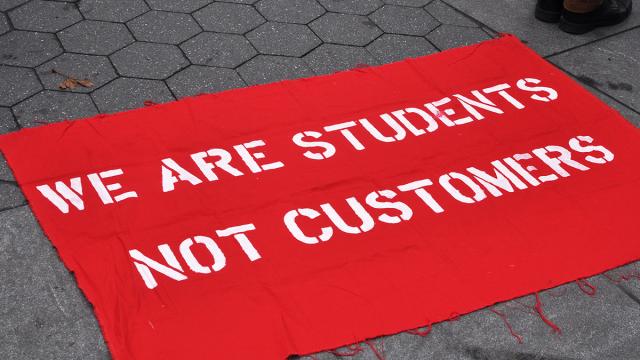
An active debt resistance movement is seizing hold across the United States. Currently, the debt strikers number over 100 students who are refusing to pay back the student loans they borrowed to go to the now-defunct for-profit Corinthian Colleges. The move has attracted media attention and could potentially provide a platform for a larger student debt movement to expand from here. However, students of history take note: this isn't the first time there have been debt resistance movements in the United States. And the lessons we learn from prior movements can just as easily be applied to today’s situation. 
 
Shays’ Rebellion
While Shays’ Rebellion is something that many people don’t have much knowledge of besides it being a rebellion of farmers against the government, the issue of debt was very much centered around it.
The rebellion came about due to post-Revolutionary War economics. After the Revolutionary War ended, merchants sought to expand their profits via trading with other areas, namely the Baltic states, the Mediterranean, and France. The Baltic was unable as while New England “generally sent surplus grains, fish, and lumber abroad,"[1] these commodities were already produced in the Baltic in large numbers and the commodity that New England could offer, beef, usually spoiled along its journey. The Mediterranean was blocked off due to Barbary pirates attacking merchant ships and France was a no-go as they weren’t able to get enough credit to be able to transport their goods.
The situation was made worse when American merchants attempted to trade with the British controlled West Indies and the British “excluded New England importers from the lucrative British West Indies market and left the Americans with few means to repay English merchants for the commodities they had purchased."[2] The West Indies situation is extremely important as immediately following the Revolutionary War, “British tradesmen continued the prewar practice of offering large cargoes to American merchants on credit.” US merchants took out large loans from the British with the assumption that that they would be able to take advantage of the West Indies market and make enough money to pay off their debts that way. When this proved impossible, the economic situation became critical as the merchants were at major risk of defaulting on their loans which could have severe economic repercussions not just with regards to trade with the British, but also domestically.
In order to continue with their business, the merchants pressed shopkeepers to which they had loaned to for funds and in turn the shopkeepers pressed the farmers to pay back their loans. Most farmers were used to paying back their debts with crops rather than cash and thus didn't have much cash on hand. This quickly landed many farmers in court where their land was at stake or in debtors' prisons. While the shopkeepers were desperate, such actions only heightened in tensions between the urban middle-class merchants and the poor farmers.
In response to this, New England farmers began to organize and resist their debt burdens. The first order of business was to push for reform, via town meetings and county conventions, in favor of state-issued paper money and tender laws, rather than the bullion coins used in that day. This was rejected wholesale by the business class and since many New England legislators were located in coastal cities and needed the support of businesses, they too, rejected the call for reform in 1785 and 1786.
While the meetings were going on, the farmers also wrote petitions to their respective state governments. For example, in Massachusetts, between 1784 and 1787, yeomen in seventy- three rural Massachusetts towns sent petitions to the General Court of Boston and in New Hampshire, from January 1784 to late September 1786, “yeomen in forty-one towns forwarded complaints to the state assembly."[3]
The tactics of the farmers began to take a turn in late 1786 as the protests were doing virtually nothing to get the reforms the farmers needed. During that time protesters armed themselves “and proposed 'moderating government' by planned attacks upon the court system.” However, this rebellion didn't last long as in Massachusetts, the governor called Congress to raise up forces and even though they were only able to raise one thousand troops, the rebellion was quickly put down.
Almost 150 years later, another debt resistance movement would take place, also centering on farmers and the oppression they dealt with. However, the tactics would change with the times as unions made by and for the oppressed advocated for them.
The Resistance to Sharecropping
Sharecropping is something that, along with convict leasing, is rarely mentioned in many history classes. The general myth is that after the Civil War ended, slavery ended with the passing of the thirteenth amendment. The reality is quite different as the oppression of African-Americans didn't end, but rather took the form of convict leasing and also sharecropping. Sharecropping was essentially debt slavery and, as M. Langley Biegert notes in the Journal of Social History, many blacks thought that sharecropping was “often little better than the old system of slavery” and some even went so far as to “[argue] that it was even more dehumanizing than slavery."[6] In order to combat this system, sharecroppers- both black and white alike- began to organize against their oppression.
In July 1934 in Tyronza, Arkansas, eighteen sharecroppers and tenant farmers “met in a local schoolhouse to discuss the idea of forming a union for non-landowning farm workers,"[7] as people were being evicted from farms due to the New Deal incentives to cut back on farm production. In response to this, the workers decided to stand up for themselves on a collective basis, across racial boundaries, and formed the Southern Tenant Farmers Union.
It should be noted that something such as this was not an easy decision to make as the risk of retaliation was quite real as can be seen in the case of former slave Bryant Singfield. Singfield “tried to organize farm workers in Phillips County who were trying to negotiate new labor contracts."[8] He had been kicked off of the plantation he was had worked on as a slave due to his outspokenness, after which he began to organize the former slaves who had decided to stay on the plantation as contract workers. He was quite successful and some people felt emboldened enough to even go beyond the demand for collective bargaining. This greatly angered the planter class and so they targeted Singfield, who, along with other protesters, were rounded up by white planters and never heard from again. However, the members of the Union made their decision and quickly began agitating for workers. One of their notable early actions was the Missouri Sharecropper Demonstration in 1939, where the Union advocated on behalf of sharecroppers.
Many sharecroppers and tenant farmers who worked in Missouri worked in the Bootheel region which was prime real estate for cotton farming. However, in 1939, “the U. S. Army Corps of Engineers announced it would deliberately breach the levee that protected the richest cotton land in the Missouri Bootheel in order to relieve pressure on the levees guarding the city of Cairo, Illinois."[9] This aided in the acceleration of getting rid of sharecroppers and tenants and switching instead to day laborers and increased mechanization. While the New Deal did set up the Agricultural Adjustment Administration, which was to give checks to sharecroppers and tenant farmers, the checks were given to the planters who would keep money and evict the workers. This was made all the easier by the fact that the final arbitrator of any disputes between planters and workers was settled by the county committees which consistently sided with the planters.
In response to this, members of the Union engaged in wildcat cotton-picking strikes in the autumn of 1938. This in and of itself didn't do much, however, it was a serious form of debt resistance as if the sharecroppers didn't work, they were unable to pay on the debts that they owed. By refusing to work, the sharecroppers were effectively engaging in an act of debt resistance.
The Union became more involved upon receiving calls of aid from members. To this end, the Union ultimately helped to organize a roadside demonstration where they demanded a living situation akin to those living on land from the Farm Security Administration which “was compelling because it preserved the social worlds of small farmers on independent homesteads, an aim that continued to resonate with landless people despite the dramatic economic changes that made such an outcome less and less possible."[10] Overall, many of the protesters just wanted their own farms. This would allow for them to work independently rather than having to endure the suffering of sharecropping.
Lessons Learned
So, why does any of that matter? What are the lessons that we can take from these movements and apply to today?
With regards to Shays' rebellion, we can apply two things: (1) have a clear, coherent message and stick to it and (2) escalate the situation over time. With regards to a clear message, the best thing that student debt activists can do it to all get on the exact same page so that there is one message that is repeated again and again. This will only help as it serves as a guiding light, a goal that is to be achieved.
In escalating the situation, there is obviously not be a call for violence as that is completely unneeded for this movement and so when it comes to turning up the heat, it just means that the activists should, over time, up the ante, doing things such as blocking roads and disrupting traffic as can be seen in the Black Lives Matter movement. It should also be noted that the farmers engaged in a diversity of tactics, doing some simultaneously, and that that should also be on the table. One should not stop protesting or slow down protesting when negotiations begin, but rather work to increase the volume of the collective voice.
The sharecropping protest should keep us reminded that while having leaders can be a good thing, they can also be targeted by the establishment whether in terms of disappearance as is what happened to Singfield, or co-optation. This can also been seen as an argument for horizontal organizing, especially when one takes into account the wildcat strike that took place. A second lesson we can learn is that activists should have each others backs and that when one group is crying out for help, we respond quickly and swiftly. Finally, individual activists should also be able to keep their autonomy and engage in actions that they see fit and can work within the context of their situation.
These lessons may be able to help the student debt movement as it would allow for people and groups to have their own autonomy to develop new protest tactics all while staying on message and to, no matter what, speak with one voice. Horizontal organizing, as seems is quickly becoming the norm for modern protests, also aids in the movement as there are no leaders to attempt to corrupt and it makes sowing dissent and discord all the more difficult. If we are to win this fight, we will have to use every tool available to us, so let's get started!


Endnotes

1: David Szatmary, Shays' Rebellion: The Making of an Agrarian Insurrection (Amherst, Massachusetts: University of Massachusetts Press, 1984) pg 20

2: Szatmary, pg 19

3: Szatmary, pg 38

4: Devon Douglas-Bowers, Slavery By A Different Name: The Convict Lease System, The Hampton Institute, http://www.hamptoninstitution.org/convictleasesystem.html#.VTGqoZPsYZx (October 30, 2013)

5: Devon Douglas-Bowers, Debt Slavery: The Forgotten History of Sharecropping, The Hampton Institute, http://www.hamptoninstitution.org/sharecropping.html#.VTGqqJPsYZx (November 7, 2013)

6: M. Langley Biegert, “Legacy of Resistance: Uncovering the History of Collective Action by Black Agricultural Workers in Central East Arkansas from the 1860s to the 1930s,” Journal of Social History 32:1 (1998), pgs 76-77

7: Biegert, pg 73

8: Biegert, pg 79

9: Jarod Roll, "Out Yonder on the Road": Working Class Self-Representation and the 1939 Roadside Demonstration in Southeast Missouri, Southern Spaces, http://www.southernspaces.org/2010/out-yonder-road-working-class-self-representation-and-1939-roadside-demonstration-southeast-mis#section3 (March 16, 2010)

Wednesday, November 26, 2014

In Defense of Ferguson

Image Courtesy of BBC


I think that we've got to see that a riot is the language of the unheard. And, what is it that America has failed to hear? It has failed to hear that the economic plight of the Negro poor has worsened over the last few years.”- Martin Luther King Jr., Interview with Mike Wallace, September 27, 1966

Now, let's get to what the white press has been calling riots. In the first place don't get confused with the words they use like ‘anti-white,’ ‘hate,’ ‘militant’ and all that nonsense like ‘radical’ and ‘riots.’ What's happening is rebellions not riots[.]”- Stokley Carmichael, “Black Power” speech, July 28, 1966


Many people are telling the people of Ferguson that they should not riot, that it is only hurting their community and they should instead engage in peaceful protests. However, this is deeply problematic as it ignores a number of issues.

People’s main concern regarding the riots in Ferguson come from a concern about private property. One could say that people are more concerned about the theft and destruction of private property than human life, but this needs to be made much more clear. People are more worried about the smashing and theft of inanimate objects than they are about human life. But it isn’t specifically human life, it’s black human life that many of these people could care less about.

On a deeper level, this is where capitalism and racism intersect. One of capitalism’s main tenets is the dominance of private property and how it must be protected. We can see that this has been transcribed in law, such as with the Stand Your Ground laws. Yet, also within the larger society there is a lack of caring for black life. In any situation, the media and general public regularly engage in victim blaming and look for anything, anything at all to assassinate the character of those who died at the hand of the police. This can be seen even today, when the media brings up Akai Gurley’s criminal record when discussing his death at the hands of a police officer. These two ideas have come together in Ferguson, creating a situation where people are more concerned about private property destruction than they are about the death of Michael Brown.

Many argue that the people of Ferguson are destroying their own community. Yet this is false. To quote Tyler Reinhard: “we don’t own neighborhoods. Black businesses exist, it’s true. But the emancipation of impoverished communities is not measured in corner-store revenue. It’s not measured in minimum-wage jobs. And no, it’s especially not measured in how many black people are allowed to become police officers.” The neighborhoods like Ferguson were not created by black people, they were created due to racist housing policies that black people had no control over. It should also be noted that Ferguson is 60% black, but has an almost entirely white police force and that the city government and school board are also almost completely white. So while they may live there, the black residents of Ferguson have little representation in the local community and are essentially living under a group of people that isn’t responsive to their concerns.

With regards to the riots themselves, the larger society is asking why don’t the protesters remain peaceful. The answer is two-part: peace has been tried and we are going to be condemned no matter what.

Society asks why aren’t the protesters peaceful, however we have to ask this: Why would you think that people would remain peaceful in the face of constant violence? Why would a people remain peaceful when their young people are being killed on an seemingly weekly basis by the very people who are supposed to protect them?

Black people have tried peace before. We were peaceful in the 1960s when we were peacefully protesting for our civil rights and were met with racist mobs, firehoses, and dogs, we had crosses burnt on our lawns, lynchings, and a bomb put in a church. During all of that time we remained peaceful even as society enacted massive violence and repression against us. Yet, violence against the black community continues today, the only difference is that it isn’t so blatant. Martin Luther King Jr. was nonviolent and died at the hands of an assassin, a violent act. Look at the Occupy protests, which were entirely nonviolent, the protesters were still met with violence, most notably in the form of a pre-dawn raid on Zuccotti Park. So even when protesters are nonviolent, they can still be met with violence.

The situation is currently such where if a black person is killed by the police, people immediately come out and find anyway in which they can besmirch or blame the victim, such as with the aforementioned example involving Akai Gurley. So they are already looking for ways to take the blame off of the authorities from day one. The situation changes, though, when oppressed people fight back. Not only is the violence denounced, but then it is used as an excuse to use massive amounts of violence against the oppressed, as we saw by the militarized police that have been used in Ferguson.

When people lash out against one incident, one may be inclined to call that violence, but when violence against your community has been going on for decades and people lash out, that’s no longer violence on the part of the oppressed, that’s called resistance.

When the question is raised of why aren’t there peaceful protests, it is also extremely hypocritical. Many have spoken out in person and on social media condemning the riots, but at the same time they are silent on the constant police brutality that the black community deals with and they are silent on the economic violence done against black communities, pushing them into ghettos where not only is there economic poverty but also a poverty of expectations. On a larger scale, they are also silent when other groups riot, such as when white people rioted over pumpkins. It is extremely hypocritical to speak out against rioters, but not have a thing to say about police brutality or to ignore others who riot.

At the heart of this is how society condones state violence, but condemns violence by individuals. This mindset is a serious problem as it only gives more power to the state and consistently puts state forces in the right, with the victims of state violence being forced to prove their innocence, a situation made all the harder due to people already assuming that the victim is in the wrong.

Many have pushed for peace, but peace and safety are not something the black people in America receive, whether we are just looking for help after a car accident, as was the case with Renisha McBride, or we are carrying a toy gun around, as was the case with John Crawford.

This is not the time to ask for peace. This is the time to say “No justice, no peace.”

Thursday, October 9, 2014

Days Of Darkness, Sparks of Hope


Currently in the United States we live in an extremely polarized political sphere. People not only seek out news and op-eds that reinforce their own viewpoints but also associate mainly with others who also align with them politically and viciously demonize ‘the other side.’ The situation has gotten to the point where people view the policies of the opposing party as a threat to the nation.

Globally, it seems that the situation is even worse as problems arise in the Ukraine, the West is once again embroiled in a war in the Middle East, and the knowledge that we’ve already seen irreversible damage due to climate change and we are getting ever-closer to the 2017 deadline where climate change will truly be permanent. These are dark days; however there is room for optimism. Around the world we have seen unlikely political alliances that are working to fight for a better future.

The Cowboy-Indian Alliance


The Cowboy-Indian Alliance made waves back in April 2014 when they led a five day ‘Reject and Protect’ campaign in Washington D.C. against the proposed Keystone XL pipeline. The action was quite prominent, although the origins of the alliance haven’t fully been bought to light, nor the historical importance of such an alliance.

Art Tanderup, a Nebraska farmer who has actively protested against Keystone XL, stated in an April 2014 interview that the alliance formed years ago due to the “common interests between farmers, ranchers and Native Americans in northern Nebraska and southern South Dakota. We’ve come together as brothers and sisters to fight this Keystone XL pipeline, because of the risk to the Ogallala Aquifer, to the land, to the health of the people.”

The pipeline is a common threat to both communities, as the Ogallala Aquifer, a water tablet located beneath the Great Plains, not only provides water for 2.3 million people, but also “threatens the Missouri River, which provides drinking water for probably a couple 'nother million,” bringing the grand total to about five million people whose clean water supply is under threat due to the construction of the Keystone XL pipeline. In addition, the aquifer also provides water for animals, livestock, and irrigation. All of this means that the pipeline threatens the health and economic stability of the Midwest.

For the Rosebud Sioux Tribe and the Great Sioux Nation, there is also a historical significance as well. Tanderup stated in the interview that part of the pipeline’s route as well as part of his farm “is on the Ponca Trail of Tears from back in the 1870s, when Chief Standing Bear and his people were driven from the Niobrara area to Oklahoma.”

The extraction processes, such as tar sands mining and the refining and dilution processes, used to obtain the oil are extremely dangerous. Gary Dorr noted in the same interview that before the oil extraction started, Fort Chip in Canada had “a negligible cancer rate” and now they “[have] a cancer rate 400 times the national Canadian per capita average” and that “every single family [in Fort Chip] has cancer in their families.”

Yet, while this is significant due to the serious environmental and economic consequences, there is also a historical importance to this as well. The alliance actually isn’t new, but is rather “a later incarnation of an alliance that was first formed in 1987 to prevent a Honeywell weapons testing range in the Black Hills, one of the most sacred sites in Lakota cosmology – where, in the 1970s, alliances successfully fended off coal and uranium mining.” This current movement is the continuation of a fight for the environment that protects people rather than profits.

This is also effecting Native American-White relations. Take the story of Mekasi Horine, a member of the Ponca Tribe of Oklahoma who is a Native rights and environmental activist.

When first hearing of the Cowboy Indian Alliance, he was rather skeptical, saying “I’ve always been a little bit bitter toward white society” and “I’ve experienced a lot of racism—growing up on the res, living on the res. When I went to town I was always treated differently than others.” However, he eventually joined due to his mother convincing him that the alliance was of importance that the cowboys “have that love and respect for the land the same that we do.” Cooperation is due having a shared love for and reverence of the land.

This alliance is having far-reaching effects as it is not just an environmental alliance, but it “is beginning the dialogue not just about broken treaties, but about the long history of colonization, the effects of which are ongoing among some of the United States’ poorest populations.” This can be shown by the fact that both sides “hope that the pipeline, which has caused them both much distress, will be a catalyst for reconciliation” and that they “sense that the reconciliation their work is a part of has a historic importance, something healing for both settlers and natives—and both feel that it is, in some way, destined to happen.”

Does this mean that everything will be smooth sailing between Native Americans and settlers from here on out? Not in the slightest, however it does offer some hope a sort of reconciliation and reckoning will take place and change the views of many so that they will aid the Native Americans in their fight not just for equal rights, but to undo the damage done by over a century of mistreatment and cultural destruction.

Fighting For Peace In Palestine


The Israeli-Palestinian conflict has been going on since 1948, with both groups claiming the same land and there is currently no end in sight. While the media may have some thinking that both Palestinians and Israelis hate each other, there has been a large amount of support for the Palestinian cause as of late from Israelis and Jews.

The International Jewish Anti-Zionist Network took an ad out in the New York Times, which was “signed by 40 Holocaust survivors and 287 descendants and other relatives” and “[called] for the blockade of Gaza to be lifted and Israel to be boycotted.” More specifically, the ad stated that they were “alarmed by the extreme, racist dehumanization of Palestinians in Israeli society, which has reached a fever-pitch. In Israel, politicians and pundits in The Times of Israel and The Jerusalem Post have called openly for genocide of Palestinians and right-wing Israelis are adopting Neo-Nazi insignia.” The ad ended arguing for collective action, reading: “We must raise our collective voices and use our collective power to bring about an end to all forms of racism, including the ongoing genocide of Palestinian people.”

Actions such as these are greatly important as they prove that not all Jewish people support the Israeli war machine and the wanton slaughter of innocent Palestinians.

There were also solidarity actions in Israel itself. However, it seems that it is increasingly dangerous to be anti-war in Israel as there have not only been attacks by right-wing nationalists, but the Israeli government itself cracked down on anti-war demonstrations. It even went so far as to attempt to use the IDF to ban anti-war protests, as the police must obey IDF Home Front Command orders. These orders “[do] not permit large gatherings in public during times of conflict,” which results of in people being unable to protest.

There is also increasing support for an end to the conflict in Palestine as well. In June it was noted that most Palestinians wanted a unity government and a narrow majority favored “peace talks and peaceful coexistence with Israel.” An August 2014 poll in Gaza revealed that supported a long-term truce with Israel, even as they opposed the disarmament of the strip.

While the fight for an end to the conflict and the creation of a fully sovereign Palestinian state will continue to be a long and arduous one, it is still good to know that people support peace.

Solidarity of the Suppressed

Around the world, minority communities are subject to unjust persecution in many societies, persecution which can range from discrimination and a lack or nonexistence of a political voice to outright brutalization and murder by security forces and intense repression. While oppressed groups have fought for their rights individually, rarely have we seen such groups show solidarity with one another and support one another. Fortunately, many have been voicing and demonstrating their solidarity from Ferguson to Palestine.

Black-Palestinian Solidarity


Both Black people in the US and Palestinians have shown solidarity with one another in their struggles.

To make the situation much more relatable for African-Americans, in May 2014 Kristian Davis Bailey penned the article Why Black People Must Stand With Palestine in which he noted that the police brutality faced by blacks and other minorities is directly related to the violence in Palestine as “Since 2001, thousands of top police officials from cities across the US have gone to Israel for training alongside its military or have participated in joint exercises here.”

Both communities experienced systemic mass incarceration as well: “Forty percent of Palestinian men have been arrested and detained by Israel at some point in their lives. (To put this in perspective, the 2008 figure for Blacks was 1 in 11.) Israel maintains policies of detaining and interrogating Palestinian children that bear resemblance to the stop and frisk policy and disproportionate raids and arrests many of our youth face.”

The problems of black people in the US and Palestinian people are greatly related as the security forces of both countries work together to develop tactics to oppress and brutalize our communities.

In 2012, Jemima Pierre of Black Agenda Report took a historical look of the situation that is still relevant today, noting that many black leaders spoke out in support of the Palestinian cause. Specifically she made mention that

Palestine was an important issue during the Black Power years as radicals identified with and embraced the anticolonial struggle against Israel. Huey Newton, even under allegations of anti-Semitism, stated, “…we are not against the Jewish people. We are against that government that will persecute the Palestinian people…The Palestinian people are living in hovels, they don’t have any land, they’ve been stripped and murdered; and we cannot support that for any reason.”

[…]

[Alice Walker] made the direct connection [of the Palestinian plight] to the Black experience: “Going through Israeli checkpoints is like going back in time to American Civil Rights struggle.”

By supporting the Palestinian people, Black people today are only continuing the pro-human rights legacy that has been set by many black leaders before them.

Palestinians have returned the support and solidarity of Black people in the form of supporting the people of Ferguson in their protests against the police. Al Jazeera reported that “Local authorities in Ferguson have begun responding to nightly protests with tear gas and rubber bullets. Palestinians on Twitter could relate, and shared words and images of support with the US protesters.”

The Popular Front for the Liberation of Palestine issued a statement of support with black people, saying that the organization “salutes and stands firmly with the ongoing struggle of Black people and all oppressed communities in the United States” and quoted Khaled Barakat, a Palestinian writer and activist, as saying the fight against US brutality around the world is linked and that “When we see the images today in Ferguson, we see another emerging Intifada in the long line of Intifada and struggle that has been carried out by Black people in the U.S. and internationally.”

Solidarity between Palestinians and Blacks is important and noteworthy as it shows international solidarity against oppressive social structures and governments as well as forms a space where the two groups can discuss and interact with one another, from promoting awareness about each other’s plights to exchanging resistance tactics.

Yet, there was also solidarity with Black people from the Asian community as well, with many offering critical insight on the connection between the Black and Asian struggles in the United States.

Black-Asian Solidarity

The National Council of Asian Pacific Americans issued a statement of solidarity with Ferguson, saying, in part that, “our own communities’ histories in the United States include violence and targeting, often by law enforcement.” While a statement may not seem like much, it is rather important as it notes the history of white supremacy and how that ideology is an enemy of all non-whites, no matter their actual skin color.

Soya Jung argued that what is going on in Ferguson mattered to Asian Americans as while Asians “do not move through the world in the crosshairs of a policing system that has its roots in slave patrols, or in a nation that has used me as an ‘object of fear’ to justify state repression and public disinvestment from the infrastructure on which my community relies,” the situation is still important to them due, firstly, to han.

Jung explains han as a word in Korean culture that “loosely means ‘the sorrow and anger that grow from the accumulated experiences of oppression” that has been “expressed in protests against Japanese colonial rule in 1919, in the struggle for self-determination as the Korean war broke out in 1950, during student protests against the oppressive U.S.-backed South Korean government in 1960, and again during the democratic uprising in Kwangju in 1980.” This anger against a racist system of oppression and its importance to Jung’s identity is partly what connects the events of Black and Asian America as both are victims of this system.

She then notes that Black rage “serves as a beacon when faced with the racial quandary that Asian Americans must navigate” with regards to “the invisibility of Asian death and the denial of any form of Asian American identity that doesn’t play by the model minority rulebook.”

Jaya Sundaresh took a broader view of the subject, in part discussing anti-blackness in the Asian community, writing that South Asian Americans must “work towards change in our own communities so that we do not inadvertently work to reinforce antiblack racism in this country, which is at the root of the police brutality which murdered Michael Brown.” At the end of the article, she urged others to talk with their “South Asian friends and families about Ferguson, why it is important that we stop perpetuating or staying silent on racist views in our communities, why we should vocally support those in the African-American community who are working towards change, and why we should stop keeping silent when our white friends and colleagues find ways to justify Darren Wilson’s murder of Michael Brown.”

The solidarity between Blacks and Asians is important not only to having a discussion about the problems and tensions that exist between the communities, but to eliminating those tensions and working together to strike back against a racist society.

Conclusion


Do all of these solidarity actions and statements mean that things are now okay? That Native Americans and settlers will get along, that the Israeli-Palestinian conflict will end anytime soon, or that institutionalized and internalized racism will be dismantled? Unfortunately not, however, what these alliances do represent are sparks of hope that we can radically change the situation that we currently find ourselves in.

These alliances, whether they are in the form of solidarity statements or marches, articles or tweets, should give people courage and nourishment to continue the fight for freedom and equality.
The world constantly seems like it is going to hell and many feel that that they may give up at any moment, but, to quote Welsh poet Dylan Thomas, “do not go gentle into that good night” instead one must “rage, rage against the dying light.”

The light is almost dead and the clock has nearly struck midnight, but this is the chance for everyone to give it their very best. If we are going to go down, let’s go down swinging. Let’s give ‘em hell!

Monday, December 30, 2013

Seeing Racism in a Colorblind Society

Image Courtesy of Psychology Today


All over the place people have been saying time and again that they want a ‘color-blind’ society, to not have to deal with racism or race anymore. They consistently quote Dr. King, saying that they want to be able to judge someone by the content of their character rather than the color of their skin. Many argue that the way to do this is to develop a color-blind society that ignores color. While some may hail this as a noble effort, they fail to see the downsides and how arguing for a color-blind society actually supports white supremacy.

One of the potential downsides to a color-blind society is that, ironically, it could actually foster an atmosphere that allows racism to continue. In a society that no longer sees color, what is the use for anti-discriminatory policies much less hate crimes legislation? Theoretically, there would be no need for such policies as people would not be judged on their race/ethnicity, at least, not on a blatantly discriminatory level. No hate crimes legislation would allow for racist attacks to be perpetrated against individuals without acknowledging that the act was especially heinous. The absence of anti-discrimination laws would allow for businesses to discriminate against minority groups without punishment.

Another potential downside would be the absence of affirmative action/equal opportunity policies, which have been a major benefit to minority communities (even if white women are the main beneficiaries[1]). The purpose of affirmative action is to “ensure that qualified individuals have equal access to opportunity and are given a fair chance to contribute their talents and abilities”[2] yet with AA/EO gone, it could take away even the chance of minorities and women getting a shot at going to certain colleges or attaining certain jobs. This would only increase the racial/gender disparities in regards to visibility in a field and wage disparities.

The argument of a ‘color-blind’ society would actually harm the classroom as well. Most of our history focuses on white people, specifically white men, with token acknowledgements being given to people of color and women. In a color-blind society, we would still be focusing on those same white men, but the situation would be different in that already marginalized groups could be completely ignored or changes made to the language used which results in hiding the true horrors of what occurred, as we have seen happening in the past years.[3] The same would be true for culture, as the cultural heritage of minorities could be ignored in favor of pushing a ‘color-blind’ culture which in reality is the white-dominated culture we currently have today in America.

Overall, the idea of color-blindness is deeply problematic as rather than attacking the roots of racism in our society and the negative impact racism has, color-blindness chooses to ignore it and continue the oppression and marginalization of entire peoples. Only by challenging racism on all levels, from institutionalized racism to micro-aggressions can we actually dismantle racism as an institution and truly liberate ourselves.

Endnotes

1: North Caroline State University Affirmative Action in Employment Training, Who Are The Intended Beneficiaries of Affirmative Action?, http://www.ncsu.edu/project/oeo-training/aa/beneficiaries.htm

2: Southeastern Oklahoma State University, Affirmative Action, http://homepages.se.edu/affirmative-action/4/

3: Amanda Paulson, “Texas textbook war: 'Slavery' or 'Atlantic triangular trade'?,” Christian Science Monitor, May 19, 2010 (http://www.csmonitor.com/USA/Education/2010/0519/Texas-textbook-war-Slavery-or-Atlantic-triangular-trade)